

| City/Town: • Anniston |
| Location Class: • Community |
| Built: • 1885 | Abandoned: • Unknown |
| Historic Designation: • National Register of Historic Places (1985) |
| Status: • Abandoned |
| Photojournalist: • David Bulit |
History of the Glen Addie Fire Hall
The Glen Addie Volunteer Hose Company Fire Hall holds historical significance as Anniston’s first fire station and its direct link to Glen Addie, a white working-class neighborhood established by the Woodstock Iron Company for its employees. The neighborhood was named after Addie Noble, the daughter of the city’s founder, Samuel Noble. “Glen” was added because the area’s rolling hillsides reminded Noble’s of a glen, meaning “valley” in his native Scottish Gaelic. Glenn Addie was just a small portion of Noble’s master plan for the utopian city of Anniston he’d envisioned.
The Woodstock Iron Company
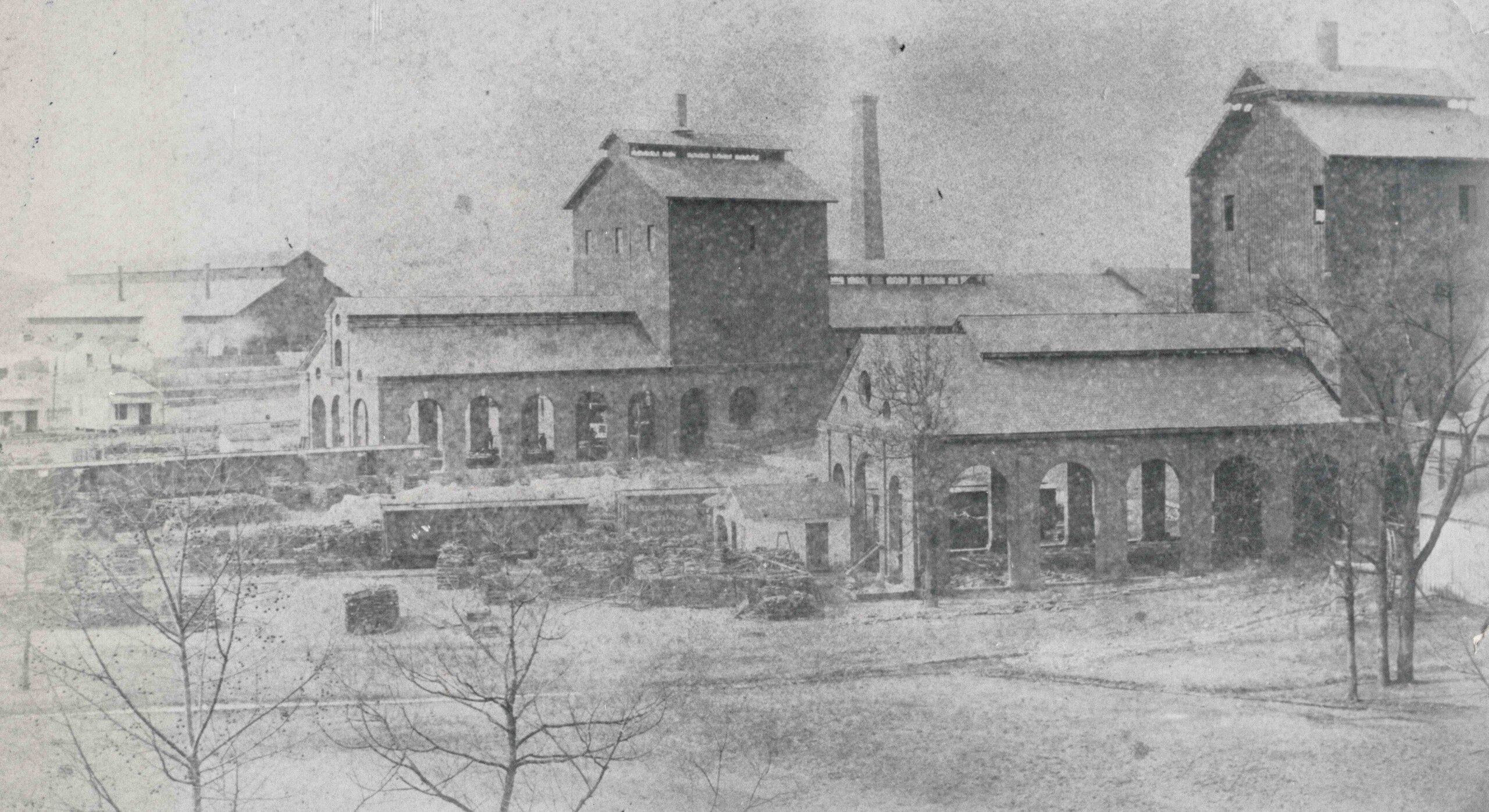
Founded during the Reconstruction era, Anniston is situated in southern Calhoun County on the former site of the Oxford Furnace. Before it became the city known today, residents of the area—then part of Benton County—nicknamed the region “Pine Ankle” due to its dense, sprawling pine forests. The town’s industrial DNA was forged during the Civil War, when the Confederacy utilized the local abundance of iron ore, limestone, and timber to establish an iron works. Though the facility fell to a Union raid in April 1865, the infrastructure remained a beacon for post-war development.
Seeking a prosperous future after the war, the Noble Brothers Iron Works of Rome, Georgia, invested in the land surrounding the old furnace. In 1872, Samuel Noble traveled to Charleston to pitch the site’s potential to Alfred Lee Tyler. This meeting eventually led to a partnership and the formation of the Woodstock Iron Company on May 4, 1872, with Tyler as president of the company.
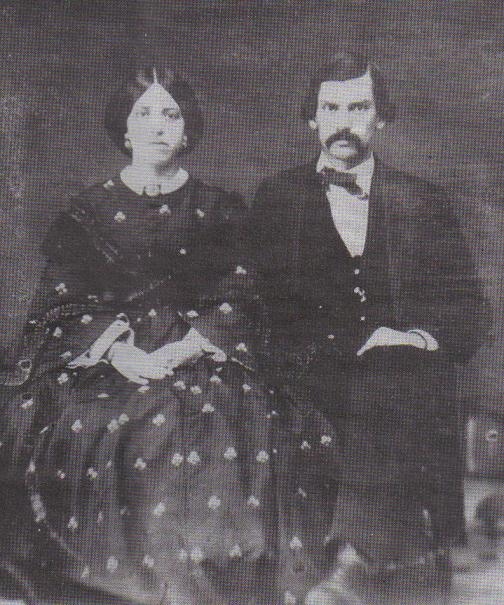
Despite the economic turmoil of the Panic of 1873, the company thrived on the strength of its high-quality “pig” iron, doubling its furnace capacity by 1879. Samuel Noble, however, saw beyond industry; he was a Gilded Age reformer with the soul of a city planner. He envisioned Anniston—named for Alfred Tyler’s wife, Annie Eliza Scott—as a “model city” and a utopian social experiment.
To realize this vision, Noble provided modern cottages complete with private yards and gardens for the company’s employees; tree-lined streets, a cemetery, and advanced water and sewer systems; a company commissary, a local farm for food security, and the construction of schools and churches; and the expansion of rail access to fuel the city’s growth.
In 1881, Anniston diversified its economy with the introduction of cotton textiles. On July 3, 1883, it was declared an “open city,” shedding its status as a private company town and triggering a massive building boom. This era of rapid expansion cemented Anniston’s status as one of Alabama’s most significant population centers for decades to come.
The Company’s Quick Decline
Between 1880 and 1890, Anniston’s population grew tenfold. The company’s monthly payroll by the mid-1880s was $50,000. This exponential growth, though, would be the company’s downfall. After fifteen years of relentless production, the environmental and economic landscape of the Woodstock Iron Company began to shift. The furnaces consumed over 30,000 tons of ore and timber annually, a pace that rapidly depleted the surrounding natural resources.
As the iron reserves waned, the company’s vast land holdings underwent a strategic identity shift: the acreage became more valuable as prime commercial real estate than as an industrial source material. In fact, during lean economic cycles, land sales became the primary driver of the company’s profitability.
In 1887, Samuel Noble initiated a pivotal reorganization plan designed to separate the industrial foundries from the company’s real estate and worker cottages. This move had significant consequences. New shares were issued to attract outside investors, leading to the controlling interest of the Woodstock Iron Company being transferred away from Alabama into the hands of major financiers in New York, Boston, and Chicago. The previously tight-knit local control began to erode.
Samuel Noble reassured locals amidst uncertainty about the city’s future, going as far as announcing the construction of two new furnaces. Unfortunately, Noble didn’t live to see their completion. In 1888, Noble died while inspecting railroad equipment in the Leatherwood section near Blue Mountain. Though he died before witnessing the full magnitude of the city’s growth, his impact was undeniable; over 5,000 mourners attended his funeral, honoring the man who transformed “Pine Ankle” into a premier industrial landmark.
After his passing, in a desperate bid to stabilize the company, executives expanded into distant coalfields, launched new railroad ventures, and pursued aggressive mergers. However, these maneuvers failed to stop the financial hemorrhaging, and debts spiraled beyond $1,000,000.
The collapse culminated on a sweltering day in July 1893, when the Woodstock Iron Company was forced onto the auction block on Anniston’s Noble Street. The proceedings were brief: a local attorney, acting as the sole bidder, secured the company and its 50,000 acres of land for the relatively modest sum of $400,000. While the purchase was made on behalf of the firm’s Northern investors, all subsequent attempts to restore the industrial giant to its former profitability ultimately foundered. Despite the company’s demise, though, Anniston continued to prosper.
Glen Addie and the Fireman’s Hall
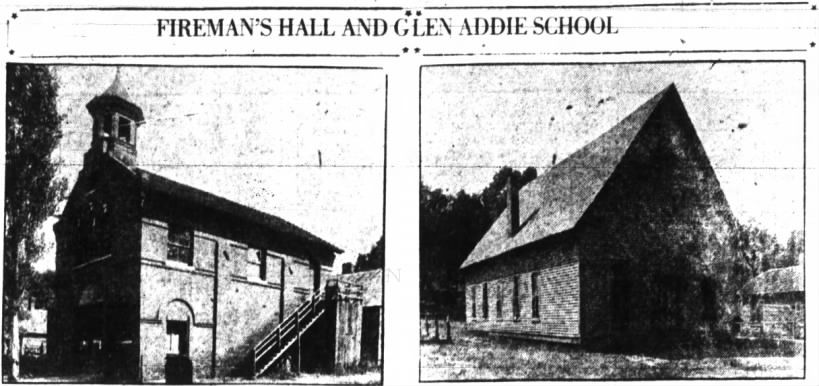
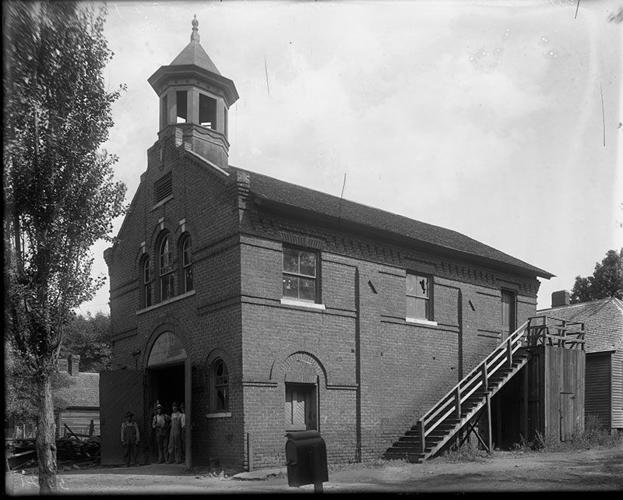
The Volunteer Hose Company was established in 1885, with the fire station located in Glen Addie. Nineteenth-century firefighting evolved from manual labor to horsepower, a transition mirrored by the crew at the Glen Addie Fire Hall, who upgraded from hand reels to horse-drawn equipment. The strict discipline required for such work is captured in Section 4 of the company’s constitution, which outlines these specific mandates for its members: “They shall visit the hose house once a week to see that the hose reel and everything belonging to the company are kept clean and in proper order.” The constitution detailed seventeen distinct fines, the most severe of which was a $2.00 penalty for intoxication on the premises.
The building’s ground floor was reserved for the “apparatus”—a specialized wagon equipped with a water tank and a coal-fired boiler used to generate steam pressure for the hoses. To ensure a rapid response, the horses’ harnesses were suspended from the ceiling, ready to be dropped instantly onto the team the moment the fire bell sounded. The horses were trained to march from their stalls out back to the appropriate spot inside the hall so that the harnesses could be attached. The names of the hose company’s horses, Todd and Lewis, are still inscribed on the first floor of the building.
Beyond its civic utility, the Glen Addie Fire Hall served as the social cornerstone for Anniston’s largest industrial neighborhood. Events like the annual Firemen’s Ball and Fireman’s Day were cornerstone traditions that united the neighborhood and fostered a deep sense of community pride.
However, the fire department vacated that building in 1917, eventually opening Station No. 2 on F Street. The department reportedly donated the bell to the old Glen Addie Baptist Church, although there are no records of that bell at the Calhoun Baptist Association.
Repurposed as a Public Schoolhouse
The first public school in Anniston was in Glen Addie, established in 1883. D. A. McKay, the school’s principal, wrote that the school’s “first term of three months was open to all white boys between the ages of seven and 21 years. In October of the same year, the City Council decided to open a free school for both boys and girls.”
Following the fire department’s departure, the city’s second public school was established in the Glen Addie Fire Hall, with classes being held on the second floor, which the students could only access via a rickety, old staircase outside. Principal McKay wrote, “The favorite recreation of the children was to slide down this shaky banister, thereby incurring the danger of an untimely fall, much to the annoyance and fear of the teacher.” By 1921, both school buildings—the fire hall and the schoolhouse across the street—were deemed inadequate, and plans were drawn up for a new school to replace them.
Later Uses
The building was soon acquired by the Rayfield family, repurposing it as commercial space, housing Rayfield’s Market and later Hurt’s Cash Store. Its role shifted back to the community in 1951 when the Anniston Parks and Recreation Department established the Glen Addie Youth Center there. By the 1960s, the Salvation Army Thrift Store had moved in, followed in the 1970s by the Rayfield-owned Vulcan Casket and Funeral Supply House.
In the early 1990s, the fire hall’s potential revival fell short when the Anniston Parks and Recreation Department and the Anniston Historical Preservation Commission applied for a federal Urban Park and Recreation grant. The proposal aimed to renovate the building into a specialized recreation center for residents with disabilities, featuring $3,000$ square feet of new meeting and workspace. However, the federal government rejected the request—which sought to cover 70% of the $245,000$ project—citing a lack of programming designed to facilitate interaction between the disabled community and the general public.
Description
At 100 years old, The Glen Addie Fire Hall was added to the National Register of Historic Places in 1985. According to the report, the description of the building reads:
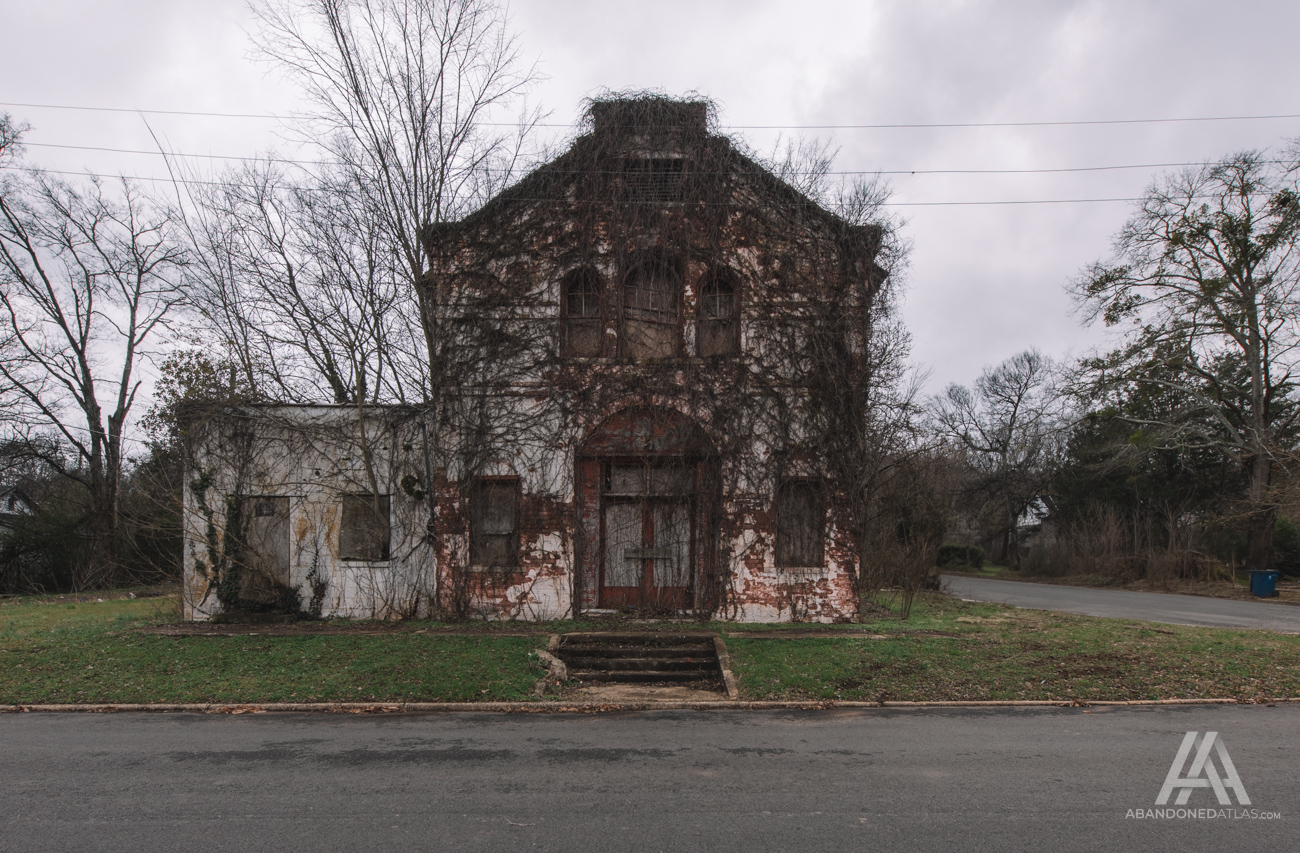
“This rectangular, two-story brick building is located on the southeast corner of 4th and Pine in what was the first residential district for Anniston Furnace Workers, Glen Addie. The building has a gable roof with its original pressed metal covering, Victorian brickwork detailing with corbelling at the cornice, and plain side elevation except for pilasters. The facade has a brick raked parapet that rises to a central flat projection. Below is a large arched doorway flanked by two arched openings, all three of which have been somewhat altered for square-headed doors and windows. Above the arched door is a triple arched window outlined by brick molding springing from a brick belt course that runs around the eaves at the top of the second-story windows. On the side, the arched first-floor windows have been bricked. An exterior stairway leads to the second floor.
On the interior, the original brick floor still has horses’ names embedded in the brick and a drain, which was used when the building was washed down.
Originally, the street level was even with the large central door, but the street level is now several feet lower, and sidewalk steps have been added. There is also a modern one-story addition attached to the east side of the building.”
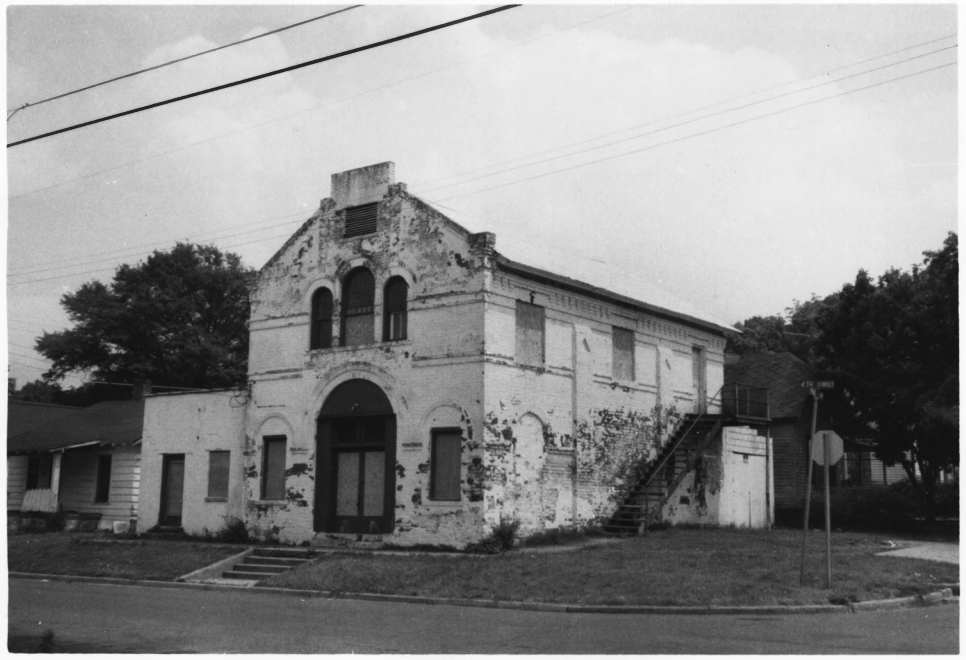
Photo Gallery


